A theme park does not always need a giant roller coaster to create an unforgettable experience. Some of the most immersive attractions happen inside enclosed spaces, where darkness, storytelling, sound, lighting, special effects and moving vehicles work together.
These attractions are commonly known as dark rides.
Despite the name, a dark ride does not necessarily mean a scary or horror ride. It refers to an indoor or enclosed attraction where visitors travel through a sequence of themed scenes. Some are designed for families, some for adventure, some for comedy, and others for genuine fear.
Today, dark rides have become an important part of modern theme park entertainment because they combine storytelling and technology with physical movement.
What Is a Dark Ride?
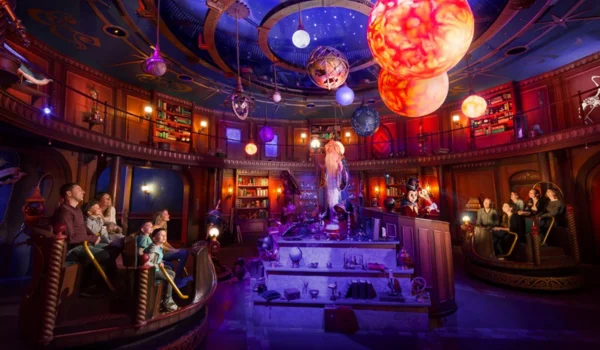
A dark ride is an attraction in which visitors travel through a controlled indoor environment containing a series of themed scenes, visual effects, characters, sounds or other storytelling elements.
The vehicle can move along a fixed track or use a trackless system.
A typical experience may include:
- A themed queue
- Pre-show or introduction
- Ride vehicle
- Multiple scenes
- Lighting and sound effects
- Animatronics
- Projection or digital media
- Special effects
- Story-based ending
The Dark Ride Database describes dark rides as a distinct category of theme park attractions found across major parks around the world.
Why Is It Called a “Dark” Ride?
The word dark generally refers to the enclosed environment rather than the emotional tone.
The attraction is usually housed inside a building where natural light is controlled.
This gives designers much greater control over what visitors see.
For example, a scene can suddenly become:
- Completely dark
- Brightly illuminated
- Filled with coloured lighting
- Surrounded by projected imagery
- Designed to reveal an unexpected character or object
Because visitors cannot see the entire ride path ahead, the attraction can create surprise and anticipation.
How Does a Dark Ride Work?
A basic dark ride follows a sequence.
- Queue and Entrance
The experience can begin before visitors even board the vehicle.
The queue may introduce:
- The story
- Characters
- Setting
- Music
- Props
- Visual clues
- Boarding
Visitors enter a ride vehicle designed specifically for the attraction.
Depending on the ride, vehicles can move continuously, stop at scenes, rotate or travel without a traditional track.
- Scene-to-Scene Journey
The vehicle takes guests through different environments.
Each scene can use a combination of:
- Physical sets
- Animatronics
- Projection
- Lighting
- Sound
- Special effects
- Story Resolution
The final scenes typically provide a conclusion or memorable finale.
The entire journey can therefore feel more like entering a movie than simply travelling on a ride.
Different Types of Dark Rides
Not every dark ride is designed in the same way.
- Traditional Scenic Dark Rides
These attractions use physical sets, figures and practical effects.
Visitors travel slowly through different scenes.
They are often suitable for families and can focus on fantasy, adventure or storytelling.
- Trackless Dark Rides
Trackless systems allow vehicles to move through a space without following a conventional fixed track.
Vehicles can:
- Change direction
- Rotate
- Stop independently
- Follow different paths
- Interact with scenes
Modern trackless systems can therefore provide more flexibility in attraction design.
- Interactive Dark Rides
Interactive dark rides turn visitors into participants.
Passengers may use:
- Blasters
- Handheld devices
- Touch controls
- Motion-based interactions
Visitors can sometimes earn points or influence what happens during the experience.
An example of the modern approach is BoldMove Nation’s interactive dark-ride concept, which combines a trackless system, gameplay, projection technology and storytelling.
- Dark Ride Coasters
These combine a dark ride with roller-coaster elements.
The experience might begin slowly inside a themed environment and then transition into:
- A launch
- A sudden drop
- Fast turns
- Inversions
- High-speed sections
This combination allows an attraction to build suspense before delivering physical thrills.
- Horror Dark Rides
Some dark rides are designed specifically to scare visitors.
They can use:
- Monsters
- Unexpected movements
- Darkness
- Sound effects
- Actors
- Animatronics
- Special effects
These attractions are particularly popular during Halloween and seasonal events.
- Motion-Based Dark Rides
Motion-based attractions combine a moving vehicle or platform with projected or physical environments.
The vehicle can tilt, rotate or move in synchronization with what visitors see.
This can create the sensation of:
- Flying
- Falling
- Driving
- Exploring
- Fighting
- Travelling through another world
- 4D Dark Rides
Some attractions add physical effects to the visual experience.
Visitors may experience:
- Air movement
- Water sprays
- Vibrations
- Seat movement
- Temperature changes
- Special smells
The aim is to involve more senses instead of relying only on visual storytelling.
Why Are Dark Rides So Popular?
- They Combine Storytelling and Movement
A roller coaster primarily delivers physical sensations.
A dark ride can deliver a story and a physical journey at the same time.
Visitors don’t simply move from one point to another—they become part of an environment.
The attractions industry is increasingly focusing on the combination of storytelling, technology, interactivity and creative design to create immersive experiences.
- They Can Be Enjoyed by Different Age Groups
Many dark rides are not dependent on extreme speed or height.
That makes them accessible to:
- Families
- Children
- Adults
- Older visitors
- Visitors who do not enjoy roller coasters
A single attraction can therefore appeal to a much broader audience.
- Darkness Creates Surprise
One of the biggest advantages of an enclosed environment is limited visibility.
Visitors don’t always know what comes next.
A door can open into a completely different world. A character can suddenly appear. A vehicle can turn unexpectedly.
That element of uncertainty creates anticipation.
- Weather Is Less of a Problem
Because dark rides are generally enclosed, they can operate with less exposure to outdoor weather conditions.
This makes them useful attractions during:
- Hot weather
- Rain
- Strong sunlight
- Certain seasonal conditions
IAAPA has also highlighted enclosed dark-ride formats that can continue operating during inclement weather.
- They Can Use Famous Stories and Characters
Dark rides work particularly well with intellectual properties.
A familiar story can be transformed into a physical environment.
Visitors may recognise:
- Characters
- Locations
- Scenes
- Music
- Story elements
A 2024 SpongeBob dark ride, for example, used animatronics, themed sets, interactive gameplay and narrative immersion to bring the Bikini Bottom world into a physical attraction.
Why Technology Has Changed Dark Rides
Traditional dark rides depended heavily on physical scenery and animatronics.
Modern attractions can combine those elements with:
- High-resolution projection
- Digital screens
- Motion simulation
- Trackless vehicles
- Interactive gameplay
- Automated show control
- Special effects
- Real-time media
The result can be a much more dynamic experience.
IAAPA’s recent attraction awards have highlighted new dark-ride concepts that combine motion, storytelling, digital media and flexible ride systems.
Dark Ride vs Roller Coaster
| Feature | Dark Ride | Roller Coaster |
| Main focus | Story and immersion | Physical thrill |
| Environment | Usually enclosed | Usually outdoor |
| Speed | Often low to moderate | Often high |
| Storytelling | Usually important | Can be secondary or integrated |
| Special effects | Major component | Usually supporting element |
| Family appeal | Often high | Depends on ride |
| Weather exposure | Low | Higher |
| Technology | Media, animatronics, effects | Track, trains, launches, sensors |
Of course, modern attractions can combine both formats.
A dark ride coaster can provide the storytelling of a dark ride and the adrenaline of a roller coaster.
Why Dark Rides Can Create Strong Memories
The strongest dark rides often engage multiple senses at once.
Visitors may:
See a new environment
Hear music and dialogue
Feel vehicle movement
Experience special effects
Interact with characters or objects
Follow a story
This combination can make the attraction feel more personal and memorable.
The modern attractions industry increasingly treats immersion as more than a visual effect; participation and emotional engagement are becoming central to the visitor experience.
Are Dark Rides Always Scary?
No.
This is one of the most common misconceptions.
A dark ride can be:
- Funny
- Magical
- Educational
- Adventurous
- Family-friendly
- Fantasy-based
- Interactive
- Romantic
- Horror-themed
The darkness is simply a design tool.
The theme and storytelling determine the emotional experience.
What Makes a Great Dark Ride?
A successful dark ride usually needs more than expensive technology.
Important elements include:
- Strong story
- Consistent theming
- Well-designed scenes
- Good pacing
- Effective lighting
- High-quality sound
- Reliable ride technology
- Interesting characters
- Surprise and anticipation
- A memorable ending
Technology works best when it supports the story rather than distracting from it.
The Future of Dark Rides
Dark rides are likely to become even more interactive and flexible.
Future attractions can increasingly combine:
- Artificial intelligence
- Real-time media
- Trackless vehicles
- Interactive gameplay
- Personalised experiences
- Projection mapping
- Augmented reality
- Advanced animatronics
This could allow the same attraction to produce slightly different experiences on different visits.
That creates another important advantage: repeatability.
If visitors can discover new scenes, scores, interactions or outcomes, they may have a reason to experience the attraction again.
Final Takeaway
A theme park dark ride is much more than a ride through a dark building.
It is a carefully designed combination of storytelling, scenery, movement, sound, lighting, technology and special effects.
Traditional dark rides focus on physical sets and storytelling, while modern versions can add trackless vehicles, interactive gameplay, digital media and sophisticated motion systems.
That flexibility is a major reason dark rides remain popular.
A roller coaster can make visitors scream because of speed and height.
A dark ride can make them scream, laugh, wonder or feel surprised because they don’t know what the next scene will reveal.
And that combination of story + surprise + immersion is what makes dark rides one of the most distinctive experiences in a modern theme park.